Choose their actual course.
Keep school-grade reading separate from Algebra 1 or Geometry. Parents can update practice tracks as enrollment changes.
READING · MATH · ALGEBRA 1 & GEOMETRY EOC
Florida-specific practice for students. Clear next steps for parents and teachers.
30 days free. No card required.Practice and parent reports for up to five children.
Start free month →Then choose: $14.99 for one child or $29.99 for up to five, through June 15, 2027. No automatic charge.
Try 6 free questions first →No account needed. Includes a practice report.
FAST Reading: grades 3–10 · FAST Math: grades 3–8
Algebra 1 & Geometry EOC: choose by course, including middle school
A museum sells 24 tickets for each of 16 tours. How many tickets are sold?
Choose an answer, then check your thinking.
Identify the given quantities and the relationship needed to solve the problem.
In your family account, completed questions feed the parent dashboard: what was practiced, what was missed, and where to spend the next few minutes.
A fixed sample from our question bank. This sample is not adaptive and does not affect a child’s progress. First answers stay saved in this browser tab for up to 24 hours.
ROOM TO KEEP PRACTICING
Site-release inventory
Across all supported grades and courses.
This is not the number available to one child. Each question is counted once; repeated attempts do not increase the total.
Math covers grades 3–8 plus Algebra 1 and Geometry course banks. Reading covers grades 3–10. Statewide Science Assessment practice covers grades 5 and 8 and is separate from FAST. Algebra 1 and Geometry are separate B.E.S.T. EOC assessments. Question count does not establish complete standards coverage or independent validation. Related questions can practice the same skill.
| Track | Math | Reading | Science |
|---|---|---|---|
| Grade 3 | 574 | 558 | N/A |
| Grade 4 | 574 | 542 | N/A |
| Grade 5 | 574 | 534 | 60 |
| Grade 6 | 590 | 534 | N/A |
| Grade 7 | 584 | 534 | N/A |
| Grade 8 | 572 | 534 | 44 |
| Grade 9 reading / Algebra 1 math | 572 | 514 | N/A |
| Grade 10 reading / Geometry math | 570 | 534 | N/A |
Algebra 1 and Geometry are chosen by course enrollment, independently of school grade. The live total follows the bank used for practice. If it cannot be reached, we label the source-code inventory included in this site release instead.
INSIDE FLORIDA FAST TEST PREP
Real app screenshots, using a fictional family and sample practice history. Choose a screen to take a closer look.
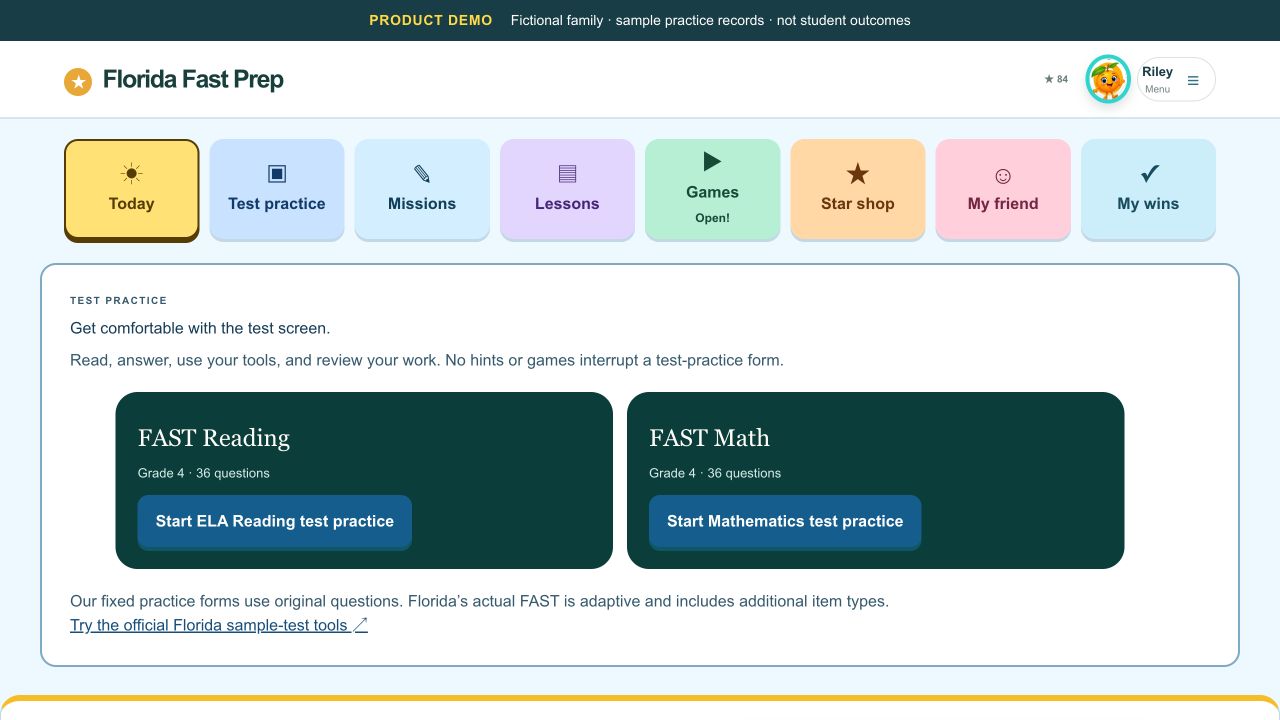
Student dashboard
Colorful shortcuts take children to missions, lessons, earned games, and the Star Shop. Parent settings stay in the parent area.
Walk through a practice session →FROM PRACTICE TO A NEXT STEP
Completed practice shows what went well and which skills need another look.
Explore the practice reports →DEMO STUDENT · FICTIONAL EXAMPLE
This illustrates the report, not a customer result or a promise of improvement. Your account shows your child’s recorded work.
See completed practice, missed skills, and a useful next step.
Explore parent guidance →Explore grade and course practice, assessment guidance, and ways to support families.
Explore teacher resources →WHY FLORIDA FAST TEST PREP?
A worksheet can give your child practice. Here, the completed work also becomes something you can follow.
Keep school-grade reading separate from Algebra 1 or Geometry. Parents can update practice tracks as enrollment changes.
Hints and explanations give students a way to revisit a practice answer. Longer assessment forms keep coaching separate from test-taking.
Parent focus areas and session history show completed work by child. You can choose a skill for the next practice session.
Children have their own access codes. Parents manage profiles, email updates, and the plan. There are no public child profiles or open chats.
HOW IT WORKS
Set school grade and math course separately.
Rehearse Read. Reason. Check., then try a short mission or a reasoning set.
Use answer explanations and a lesson when a skill needs another look.
Open the parent report and choose what to practice next.
PLANS FOR YOUR HOUSEHOLD
Choose a free month with no card, or pay once for practice through June 15. Summer is separate.
Full pricing details →2026–27 ACADEMIC YEAR
$14.99 / academic year
For one child profile.
One payment. Access through June 15, 2027. No automatic renewal.
The trial lasts up to 30 days, ending no later than June 15. Paid access ends June 15, 2027. Summer is not included.
2026–27 ACADEMIC YEAR
$29.99 / academic year
Up to five child profiles.
One payment. Access through June 15, 2027. No automatic renewal.
The trial lasts up to 30 days, ending no later than June 15. Paid access ends June 15, 2027. Summer is not included.
THE RIGHT PRACTICE FOR THEIR PATH
A seventh grader taking Algebra 1 needs Algebra 1 practice and seventh-grade reading. Set them separately, and update the course as your child moves forward.
Reading for grades 3–10. Math for grades 3–8. Practice between PM1, PM2, and PM3 with explanations and parent progress reports.
Choose school grade →COURSE-BASED PRACTICEEquations, functions, and the reasoning behind them. Select Algebra 1 whenever your child takes the course, including in middle school.
Choose Algebra 1 →COURSE-BASED PRACTICESimilarity, coordinate geometry, and mathematical explanations. Choose Geometry by enrollment, including grades 11–12.
Choose Geometry →UNDERSTANDING THAT GOES BEYOND A CLICK
Dedicated reasoning sets ask students to evaluate a mathematical explanation or connect a reading answer to evidence. Worked explanations make the thinking visible after submission.
Start a reasoning session →Reasoning results appear separately from the overall practice result. One correct answer is an encouraging start; repeated work builds a more useful picture.
Daily question selection responds to recorded skill evidence. Students ready for harder work can reach it early in the school year.
PRACTICE THAT RESPONDS
Adaptive during the assessment, responsive from day to day, and guided by you.
These are original practice questions with provisional difficulty estimates. Our adaptive practice does not reproduce the state’s scoring or predict an official FAST result.
PRACTICE THE FORMAT, TOO
Every practice form starts with a simple strategy: understand the task, work it out with evidence or scratch paper, and check before moving on. Students rehearse that routine alongside navigation and review tools.
Explore the practice format →Practice forms include tools such as notes, text highlighting, and a reading guide. Hints and answer explanations stay hidden until submission so students can practice working independently.
Our adaptive practice uses original questions and provisional difficulty estimates. Math adapts between questions; reading adapts between passage sets. It differs from the official FAST test and its scoring. Tools, question formats, and scoring may differ from the state assessment.
WHY FAST MATTERS
Stay involved in the conversations about your child’s learning, support, and school path.
FAST gives families and teachers checkpoints for planning instruction across the school year. PM1 establishes a starting point, PM2 shows midyear progress, and PM3 measures end-of-year learning. Early results help identify where more instruction and support may be useful. Read FDOE’s FAST guide ↗
Results can also matter for the next school step. Some schools and programs consider FAST scores alongside grades and other criteria for eligibility or placement. Requirements vary: ask your child’s school how results inform next year’s classes and support. See one district program’s admission criteria ↗
In grade 3, the end-of-year reading assessment has promotion implications: Level 2 or higher meets the assessment requirement, and good-cause exemptions and other approved pathways exist. Read Florida’s third-grade guidance ↗
Parents can help by reviewing school reports early, discussing patterns with the teacher, and making room for short, focused practice. Our dashboard helps you see what your child practices between school assessments; it does not decide school placement or guarantee a result.
A FLORIDA PARENT’S STARTING POINT
B.E.S.T. stands for Benchmarks for Excellent Student Thinking. Florida FAST, the Florida Assessment of Student Thinking, checks Reading and Mathematics progress during the school year.
Understand B.E.S.T. and FAST →Earlier FAST results can affect starting difficulty, but do not cap a child’s later achievement level. Encourage thoughtful effort in every window. Algebra 1 and Geometry EOCs are separate course assessments.
FDOE explains adaptive testing ↗Our questions are organized by grade, skill, and intended benchmark. Use them to practice between school assessments, then discuss recurring difficulties with your child’s teacher.
Our practice checks are independent. They do not replace PM1, PM2, or PM3, reproduce state adaptive scoring, or predict an official result.
Read FDOE’s assessment overview ↗FIND YOUR CHILD’S PRACTICE
FAST Math practice for grades 3–8, plus Algebra 1 and Geometry EOC course practice.
Explore math practice →READING / ELAOriginal reading passages and questions for grades 3–10.
Explore reading practice →Each guide includes a question from the current practice bank, grade-specific advice, and links to official assessment information.
PARENTS BEHIND THE PRODUCT
That was the problem Lauren and Jonathan Simmons wanted to solve for their own family: see the questions, understand the mistakes, and know where to spend a little time together.
Florida FAST Test Prep is operated by Simmetry Holdings. Jonathan leads Florida Fast Prep as CEO; Lauren is COO of Simmetry Holdings.
Meet the people behind the practice →Open Billing & cancellation in your family dashboard. An earlier recurring subscription has a Cancel subscription button; confirm to stop renewal while keeping access through the displayed end date. Current academic-year plans are one-time purchases with no automatic renewal, so nothing needs to be canceled. For a charge or refund question, choose billing help.
Saved answers help guide future practice, and parents can choose a skill for their child. Children can start a recommended five-question set or choose a subject and skill. Difficulty estimates are provisional; this is independent practice, not a reproduction of Florida’s testing or scoring system.
Yes. Choose school grade and math course separately. Reading follows grades 3–10; Algebra 1 and Geometry EOC practice follows the selected course, including grades 11–12. Parents can change these tracks in Settings.
No. FDOE explains that prior FAST performance can influence the starting difficulty, but students can move up as the test adapts to their current performance. Encourage careful effort in every testing window. Our adaptive practice uses its own selection rules and does not reproduce Florida’s scoring.
FAST means Florida Assessment of Student Thinking. It is the state’s Reading and Mathematics progress-monitoring assessment. Your school administers the official assessments and provides the results; Florida Fast Prep is separate at-home practice.
B.E.S.T. means Benchmarks for Excellent Student Thinking. The standards describe knowledge and skills by grade or course. Our questions carry intended benchmark labels so you can see what the practice targets; those labels do not mean state endorsement.
Students work in grade-specific reading and math activities with hints, explanations, and a saved record of completed work. Parents can review skills and sessions for each child. Worksheets can also be useful; the added value here is the connection between practice and the parent view.
Reading practice follows school grade in grades 3–10. FAST Math covers grades 3–8. Science practice is available in grades 5 and 8. Algebra 1 and Geometry EOC practice follows course enrollment, including middle school and grades 11–12. Choose school grade and math course separately when creating or editing a profile.
Create a parent account and a child profile. Practice, lessons, rewards, and parent progress are available for up to 30 days, ending no later than June 15, 2027. No card is required. The trial never charges you automatically.
Choose Single Child for one child or Family for up to five. Current plans are one-time purchases for the remaining 2026–27 academic year, through June 15, 2027, with no automatic renewal or summer access. Review the current price and coverage on Pricing and at checkout before purchasing.
No. It reports work completed in this app: answers, skills practiced, and session history. A missed question can suggest what to review, but it cannot establish a learning difficulty or predict an official score. Use school reports and your child’s teacher for that wider picture.
No. Those are the school’s official FAST progress-monitoring assessments. Our practice can be used between school assessments, but it is not an official form, a replica of the state’s adaptive test, or a substitute for school testing.
Florida Fast Prep provides original questions organized by grade, skill, and benchmark. AI assists with parent-facing practice summaries and skill lessons; children do not have an open AI chat. We do not claim FDOE approval, independent curriculum certification, or guaranteed score gains. If a question looks wrong, send its wording and grade through Support so it can be checked.
START WITH ONE SESSION
30 days free. No card required.