HOW FLORIDA FAST TEST PREP WORKS
A question, an explanation, and a useful next step.
Here is what a family does from account setup to the next practice session.
Adaptive practice, with a parent’s direction
Adaptive during the assessment, responsive from day to day, and guided by you.
- Question by question in math. Answers guide the difficulty of the next assessment question while keeping the planned content coverage. Reading adapts between passage sets so connected questions stay together.
- Day by day as your child progresses. Saved answers and skill history guide future daily practice sets, helping your child revisit skills that need attention and move toward harder work.
- A parent can set the focus. Choose a skill for today’s practice from the parent dashboard, for example, something your child’s teacher wants reinforced. The usual progress-based path resumes the next day.
These are original practice questions with provisional difficulty estimates. Our adaptive practice does not reproduce the state’s scoring or predict an official FAST result.
1. The parent creates the family account
Add a nickname, school grade, and math course for your child, then choose a password or generate an access code. Reading follows school grade through grade 10; Algebra 1 and Geometry are selected by course, including middle school and grades 11–12. The parent and child use separate sign-ins. You can add up to five child profiles to the family account.
The complimentary account trial lasts 30 days and does not require a card. Read the plan details.
2. Your child chooses what to practice
Choose a subject and rehearse Read. Reason. Check. before practice. Try a dedicated reasoning set to examine an error, connect ideas, or support a reading answer with evidence. Skill-focused sets help revisit a specific area. Baseline checks and longer practice assessments serve different purposes.
3. Review the answer, not just the result
In practice mode, use a hint or answer explanation to work through a mistake. A short lesson can help with the skill behind it. In assessment mode, coaching stays hidden until the form is submitted.
Children can also earn stars and personalize their profile through practice. See how rewards work.
4. Open the parent dashboard
Choose the child you want to review. Overview, Focus areas, and Sessions organize completed work so you can choose a skill for the next session. The reasoning view shows results for questions tagged for explanation or evidence. Keep the results in context: the app reports practice, not an official FAST score.
The screens along the way
INSIDE FLORIDA FAST TEST PREP
See what students and parents actually do.
Real app screenshots, using a fictional family and sample practice history. Choose a screen to take a closer look.
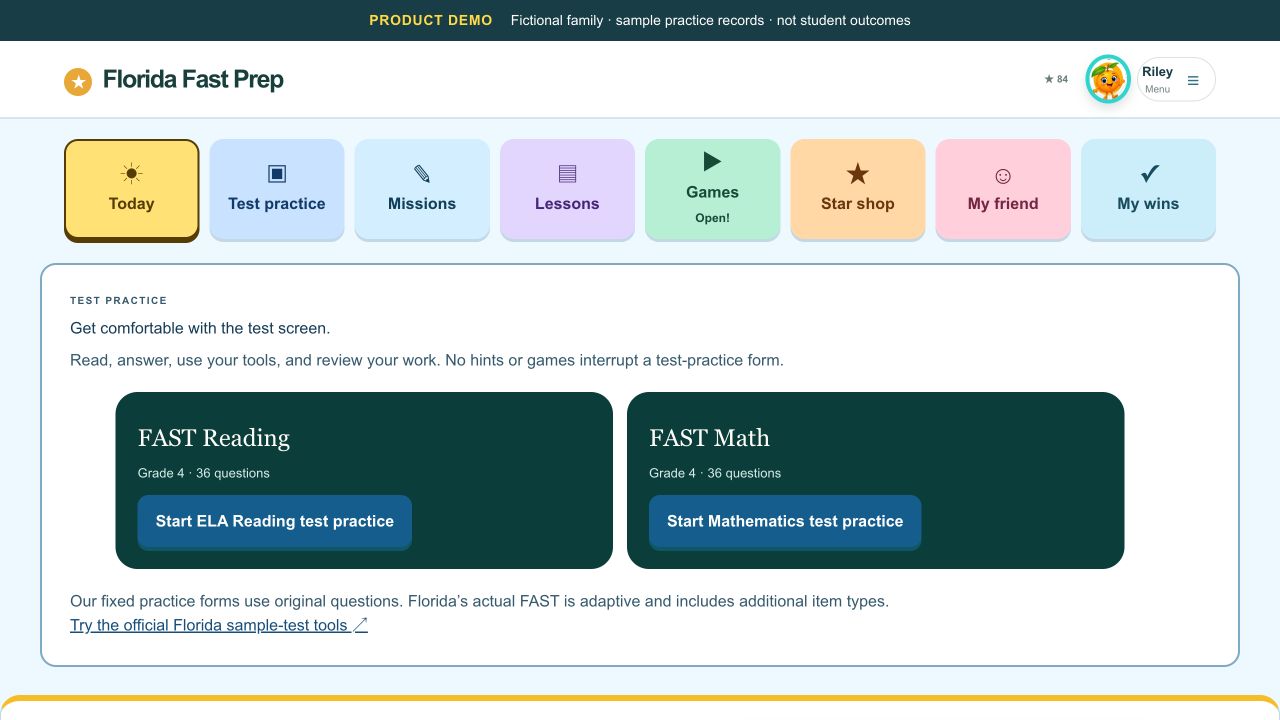
Student dashboard
Their own space to learn and explore.
Colorful shortcuts take children to missions, lessons, earned games, and the Star Shop. Parent settings stay in the parent area.
Walk through a practice session →Why school FAST results matter
FAST gives families and teachers checkpoints for planning instruction across the school year. PM1 establishes a starting point, PM2 shows midyear progress, and PM3 measures end-of-year learning. Early results help identify where more instruction and support may be useful. Read FDOE’s FAST guide ↗
Results can also matter for the next school step. Some schools and programs consider FAST scores alongside grades and other criteria for eligibility or placement. Requirements vary: ask your child’s school how results inform next year’s classes and support. See one district program’s admission criteria ↗
In grade 3, the end-of-year reading assessment has promotion implications: Level 2 or higher meets the assessment requirement, and good-cause exemptions and other approved pathways exist. Read Florida’s third-grade guidance ↗
Parents can help by reviewing school reports early, discussing patterns with the teacher, and making room for short, focused practice. Our dashboard helps you see what your child practices between school assessments; it does not decide school placement or guarantee a result.
Try it with your family.
30 days of practice and parent reports. No payment card required.
Start free month